




- Wasabi Protocol suffered a liquidity pool drain of more than $5 million, affecting multiple crypto assets like Ethereum, Base, and Pepe.
- Web3 traced the fault to an operational failure stemming from a compromised admin key.
- Several accounts have attempted to milk the situation, misleading Wasabi users into visiting a fake website supposedly to safeguard their accounts and assets.
Wasabi Protocol, a decentralized perpetual trading platform built on Ethereum (ETH) and Base (BASE), becomes the latest victim of a multi-million-dollar exploit. Its core team confirmed the incident, but has garnered backlash from the crypto community as details of the matter are starting to surface.
$5M Exploit on Wasabi Protocol
Around Thursday morning (UTC) today, several blockchain security companies sounded the alarm on a series of anomalous transactions occurring across multiple chains. These included Ethereum, Base, Berachain (BERA), Pepe (PEPE), Mog Coin (MOG), and Blast (BLAST). At the time of the warning, the attacker had already siphoned more than $5 million worth of the mentioned assets.
Hours later, Wasabi Protocol acknowledged the malicious activity in its ecosystem. The decentralized finance (DeFi) derivatives platform said that it has launched an investigation into the incident. Additionally, it advised users not to interact with Wasabi contracts while it looks into the matter.
Operational Failure Blamed on the Attack
Several Web3 security specialists, including Blockaid, Certik, Cyvers, and ZachXBT, revealed that a smart contract bug didn’t cause the theft. Instead, it stemmed from a compromised admin key.
According to Blockaid’s exploit detection system, the culprit used a Wasabi deployer Externally Owned Account (EOA) to grant an admin role to an attacker helper contract. The privileged access was then instrumental in draining the underlying assets.
Wasabi Protocol’s admin key compromise drew backlash, including from ZachXBT, for giving a single EOA the ability to exercise such control without implementing additional safeguards.
Scammers Capitalizing on the Exploit
By noon, someone impersonating an official Wasabi Protocol account on X with the name Wascbi Profocol and handle “@wascbi_profocol” has posted on the official notice. It included a link that was supposed to let people revoke their token approvals on the derivatives platform. The fake website has apparently misled several people into clicking the link and interacting with it as of writing.
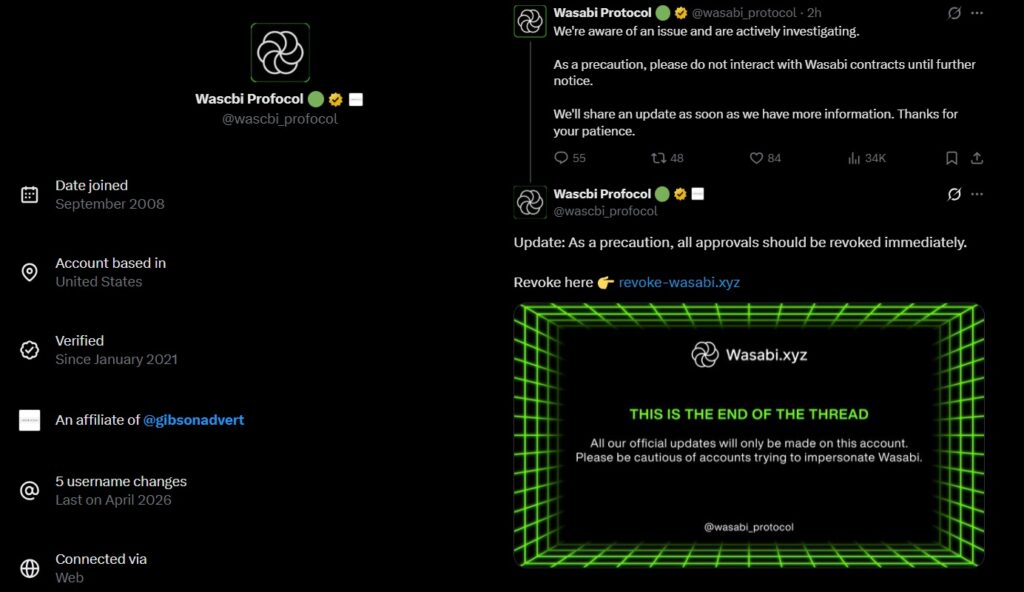
Interestingly, X verified the account in January 2021. It’s also worth noting that the account is affiliated with a certain “Gibson Design,” a recently verified account with no followers. So far, the account’s admin has changed usernames five times, with the last coinciding with the latest Wasabi Protocol incident.
It’s unclear whether the person running the account is linked to the perpetrator of the Wasabi Protocol exploit, or it’s another individual or crew looking to capitalize on the situation.
Others have also copied the technique, but this account is having the most engagement by far.