





- Bitcoin (BTC) mining firms are forced to adapt to the new dynamics past April’s halving.
- Increased competition amid lower revenues has either forced them to close shop or explore ways to significantly cut costs.
- Southeast Asia is becoming a hotbed for relocating Bitcoin miners due to the region’s low electricity cost.
- A recent event in Thailand serves as an example of how some operators are cutting corners at the expense of the public.
Post-Halving Struggles of Bitcoin Mining Companies
Bitcoin mining firms continue to face financial struggles following the significant reduction of block mining rewards from 6.25 BTC to 3.125 BTC post-halving. The pressure is amplified by the all-time low hash price of the crypto asset this month amid the higher competition within its economy.
As a recap, Bitcoin’s total hash rate went up to an all-time high of 651 million terahashes per second (TH/s) by the end of July this year.

Meanwhile, revenue per unit of mining computing power fell to a record-low of $0.035 per TH/s per day at the start of August.
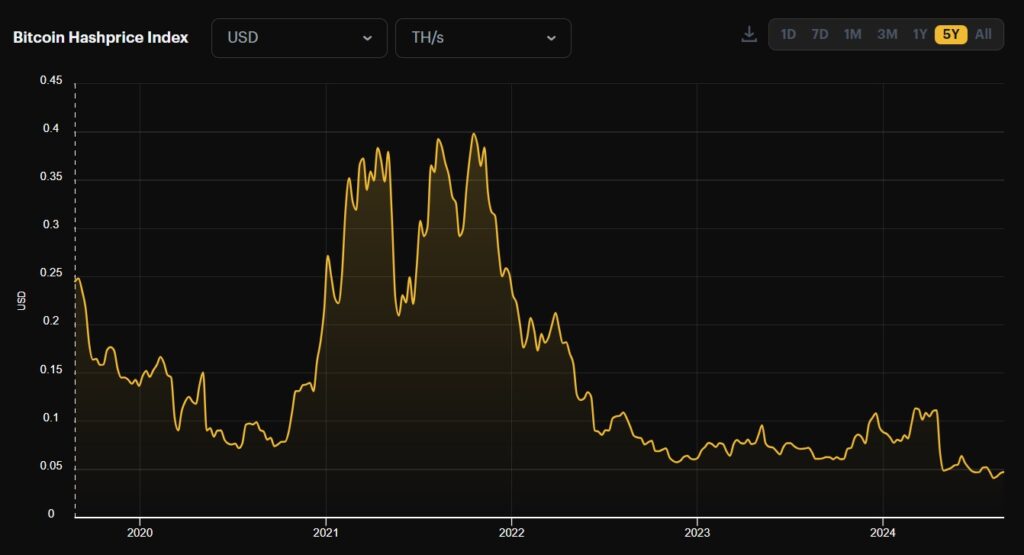
The trend puts the sustainability of the sector in question. It also raises worries about the increasing centralization of the space as a growing number of smaller players are forced to cease operations amid the increasing cost of operations, particularly in their energy expenses.
Flight to Cheaper Electricity
More resilient Bitcoin mining firms are now exploring various ways to reduce their operating costs by tapping into renewable energy resources. This somehow serves as a double-edged sword for them in terms of cost-cutting and regulatory compliance, as authorities are now tightening their crackdown on crypto mining firms due to their alarming energy requirements.
On the other hand, others are apparently cutting corners by simply moving to areas with cheaper electricity. So far, this has been a growing concern in Southeast Asia.
Bitcoin Mining Raid in Thailand
In Ratchaburi, a town west of Bangkok in Thailand, law enforcement officials raided a house suspected to be the root cause of blackouts in the locality. According to the South China Morning Post, police and officials from the Provincial Electricity Authorities (PEA) traced the power outages that have been plaguing the area for months there.
Initially, the occupants of the house denied the investigators entry on Thursday. However, the authorities eventually secured a search warrant the following day, which led to the discovery of an illegal Bitcoin mining operation in the household.
Jamnong Chanwong, a chief district security officer, revealed that the operators already moved some of the equipment during the short window of time between the issuance of the warrant. Despite that, his group still found some specialized rigs for Bitcoin mining at the time of the raid.
Chanwong said the property had been rented to a certain company for around four months. However, the outages only began in July, at the peak of its Bitcoin mining activities. The chief district security officer also showed journalists proof that the household managed to pay so little for its energy consumption despite its huge demand for electricity.
Chanwong stated that they haven’t arrested anyone yet. He claimed that the perpetrators had already fled the scene during the raid.
Thai regulators consider Bitcoin miners as manufacturers. Therefore, they can conduct their business there as long as they pay the associated taxes.