




- Bitget CEO Gracy Chen explains how the SEC Innovation Exemption addresses the regulatory barriers hindering greater participation in the tokenized equities market.
- Tokenized stocks now have a combined value of $2.93 billion, up from $9.4 million in January 2024.
Acting on its promise to continue offering guidance on cryptocurrencies regardless of the Digital Asset Market CLARITY Act’s fate in Congress, the Securities and Exchange Commission (SEC) has recently released its Innovation Exemption. The framework provides a five-year safe harbor for qualifying digital assets, particularly tokenized real-world assets (RWAs), allowing market participants to experiment and innovate without worrying about burdensome regulatory requirements.
Industry stakeholders reacted positively to the SEC’s latest efforts. Bitget CEO Gracy Chen called it an “important step” in addressing the regulatory uncertainty that has limited the expansion of tokenized RWAs.
What the SEC Innovation Exemption Says
The SEC’s order provides a conditional and temporary exemption from the Securities Exchange Act of 1934’s definition of “exchange” to certain tokenized securities venues (TSVs) that offer permissioned automated market makers (AMMs) and liquidity pools. It applies to tokenized National Market System (NMS) stocks, generally as US exchange-listed equities and exchange-traded products but not options, rights, and warrants.
The same exemption extends to the act’s definition of a “dealer.” It excludes eligible liquidity providers supplying liquidity to TSVs to participate in permissioned AMMs without immediately triggering the agency’s broker-dealer requirements.
SEC Chair Paul Atkins underscored that the move aims to “bring America’s capital markets into the digital age.” Commissioner Hester Peirce seconded it, calling it “a small step toward waking up to a tokenized tomorrow.” Meanwhile, Commissioner Mark Uyeda called the framework “scope relief to experiment responsibly, learn, and translate old protections to new contexts.”
The SEC’s interim framework goes into effect from September 17, 2026, to September 17, 2031.
Bitget CEO Gracy Chen’s Thoughts on the SEC Innovation Exemption
Chen highlighted in an email to Blockzeit that the SEC Innovation Exemption is an “important step” in bringing equities onchain. She stated that the technology has long been available, but the hard part has always been “building the rules and market structure around it so these products can work at scale.”
The Bitget CEO believes that one of the biggest opportunities in tokenization is access. She coined the process “brokering the unbrokered.”
Additionally, Chen noted that millions of investors worldwide still struggle to access US equities because of geographic and domestic market constraints. Tokenization bridges them to the opportunities offered by the American capital markets.
The Bitget boss explained that the SEC’s approach gives the industry room to test how tokenized equities can work within the existing financial system. She said putting a stock onchain is “relatively easy.” However, underlying questions remain about what happens to liquidity when traditional markets are closed, how pricing works, and whether investors can trade efficiently when volatility rises.
“We’re getting closer to the point where the question is no longer whether equities can move onchain,” Chen concluded. “It’s how we build a market around them that people can actually use.”
Last month, Bitget Research Chief Analyst Ryan Lee emphasized that RWA tokenization is one of the most interesting areas to focus on because of its exponential growth over the years. Beyond macro factors, he predicts that tokenization, alongside artificial intelligence (AI), will drive Bitcoin’s (BTC) next rally to a new all-time high.
AMC Finds Relief in the New SEC Framework
AMC CEO Adam Aron has been embroiled in a heated discussion lately with Robinhood CEO Vlad Tenev and CLO Dan Gallagher. The issue stemmed primarily from the latter’s issuance of tokenized AMC stock without the former’s official approval.
Aron argued that Robinhood’s Stock Tokens circumvent US securities laws and deprive investors of the protections and perks offered by traditional shareholding, including voting rights and dividend payments. What’s more, he said they significantly dilute institutional capital-raising controls.
For the AMC CEO, the new SEC rules make it clear “investor protection is not optional.” He takes them as validation of his earlier stance that tokenized stocks should also carry full voting and dividend rights—things not built into synthetic shares.
More importantly, the Innovation Exemption allows stock issuers to object, preventing their shares from being tokenized at their discretion. The measure gives companies control of their own securities and capital structures, rather than leaving them at the mercy of unauthorized brokerage houses and other third-party entities.
Snapshot of Tokenized RWAs
To date, tokenized RWAs have surged to more than $716.7 billion in total asset value, according to RWA.xyz. The figures show almost a 425% surge from $136.53 billion in January 2024.
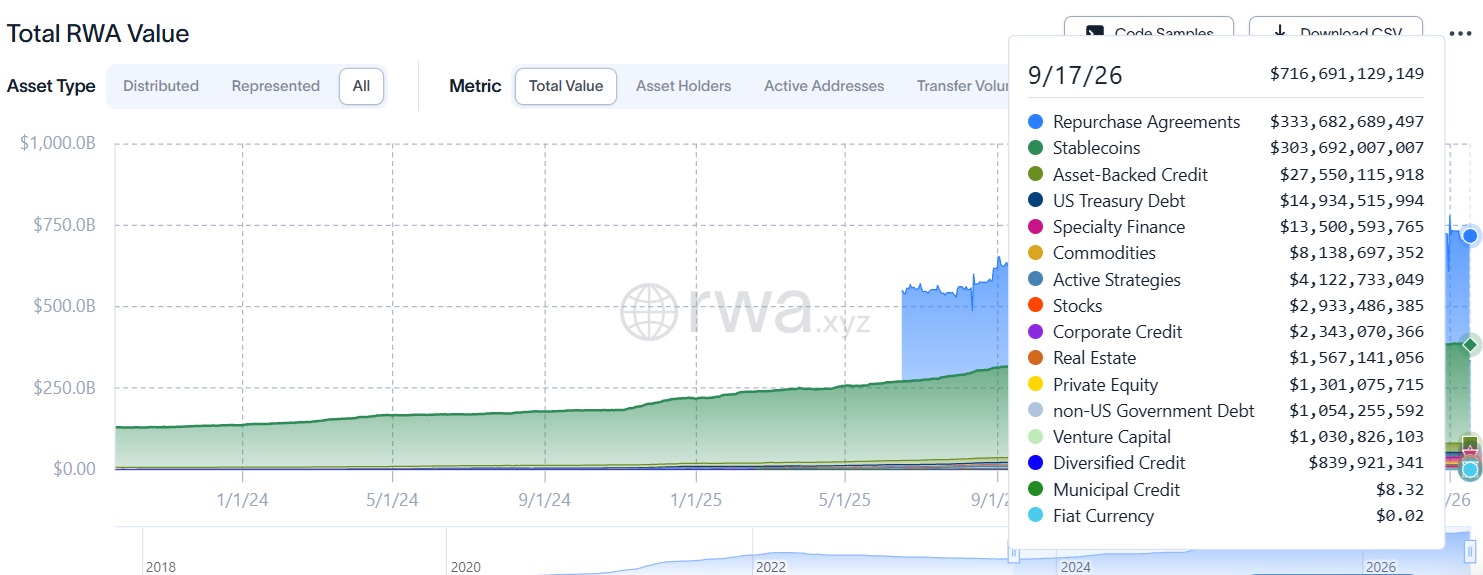
Repurchase agreements (repos) and stablecoins remain the dominant categories, accounting for approximately 88.93% of tokenized RWAs with $333.68 billion and $303.69 billion in market share, respectively.
Over the same period, tokenized stocks have risen dramatically from $9.4 million to $2.93 billion. It reflects a roughly 31,107% spike in just more than two years.
With clearer regulations and active guidance from the SEC, tokenized stocks are expected to accelerate their expansion as institutional participants gain greater trust and confidence in navigating a more predictable investing landscape. It also significantly reduces friction for legacy financial institutions integrating their capital-building infrastructure and operational workflows onchain to unlock higher efficiency, deeper liquidity, and atomic settlements.
Disclaimer: The compiled data, analysis, and commentary featured in this article are for informational purposes only. They do not constitute financial advice or a product recommendation from Bitget, the author, or the Blockzeit team.