





Pi Network started as a simple phone app that let people “mine” a coin by tapping a button. Today, it has grown into a full blockchain project with an open mainnet live in 2025 and a community that claims over 60 million registered users.
The project does have real activity: millions of Pioneers have passed KYC, moved coins to mainnet wallets, and use PI to buy and sell inside the ecosystem. At the same time, the actual market price of PI on external exchanges has stayed low in Q4 of 2025, generally in the $0.20 – $0.27 range, with thin trading and limited listings.
That mix creates a big puzzle. What could PI be worth between 2026 and 2030, and is today a smart time to slowly stack coins or better to sit on the sidelines?
That’s what I’ll cover today!
What is Pi Network and how strong is it in 2025?
Before talking numbers, I want to clarify what Pi Network actually looks like right now, not just the hype posts on social media.
From phone mining app to open mainnet with real users
Pi Network began in 2019 as a mobile mining app that let users earn PI by checking in daily and building referral circles. The idea was to grow a community first, then bring them onto a real blockchain later.
That “later” is now. In 2025 Pi rolled out its Open Mainnet, with external connectivity allowed and on-chain transactions between real wallets, not just test balances. The team built AI-assisted KYC tools that sped up identity checks and cut wait times from months to days.
By late 2025:
- Roughly 17.5 million users had completed KYC.
- Around 15.7 million had migrated their balances to mainnet wallets.
- Migration keeps growing by hundreds of thousands of users per week.
On top of that, the ecosystem is no longer just a single app. There are thousands of community-built apps and merchants. Reports from the project highlight tens of thousands of active sellers accepting PI for goods or services. The network also supports .pi domain names, which makes it easier for users and apps to build a Pi-only Web3 identity.
That scale is impressive for any new chain. It does not, by itself, guarantee a high coin price.
Current PI price, trading limits, and what that means for investors
As of December 2025, PI trades mostly in the $0.20 to $0.23 range, with a market cap just under $2 billion. But you need to treat those numbers with care.
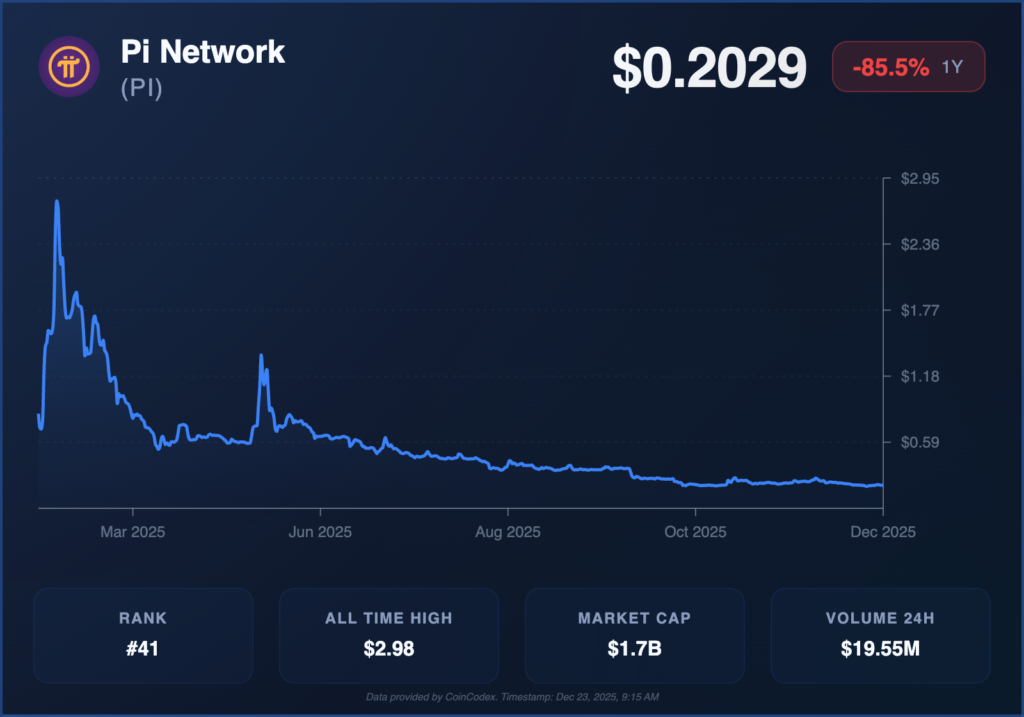
1-Year Pi Coin Price Chart
PI is not widely listed on top-tier exchanges yet. Most trading happens on smaller platforms with lower volume and less liquidity. A single large order can move the price quickly in either direction.
On-chain, PI sees more use inside its own economy. People pay in PI at merchants, use it in apps, and trade peer to peer. That activity helps the network, but it makes price discovery harder, because a big part of demand never hits public order books.
Some investors also worry about centralization, token unlock schedules, and the strong influence of the core team on key decisions. These points make major exchanges cautious and can delay broader listings.
Bottom line: the current PI price is a fragile signal. Any long-term prediction needs extra caution, because the market is still early, thin, and sensitive to shocks.
Pi Network (PI) price predictions for 2026, 2027, and 2030
Analyst sites track PI now and try to model future prices using charts, volatility, and basic growth assumptions. These tools do not have secret data. They just run math on what we can already see.
Treat every number as “if the current pattern repeats,” not as destiny.
Expert forecasts: what analysts expect for 2026 and 2027
Most mainstream PI analysis forecasts see it staying relatively cheap through 2026, with room for a slow recovery if the project keeps growing and liquidity improves.
Here is a rough picture from various sources:
- Early 2026: Many models expect weakness, with ranges around $0.14 to $0.18. That lines up with recent bearish signals and the risk of more selling after token unlocks.
- End of 2026: Base case forecasts cluster around $0.23 to $0.26, with more bullish models like CoinCodex’s PI prediction pointing to $0.50 or even higher if the wider market recovers.
- 2027: Traders Union and similar sites often show PI in the $0.36 to $0.43 zone by the end of 2027, assuming steady growth and no major disasters.
In plain terms: many tools expect a choppy, maybe painful near term, then a slow grind higher if Pi survives, gains traction, and the crypto market cycles back into a bullish phase.
Nothing in these numbers guarantees a straight line. They also don’t eflect black swan events like a huge exchange listing or a serious security issue.
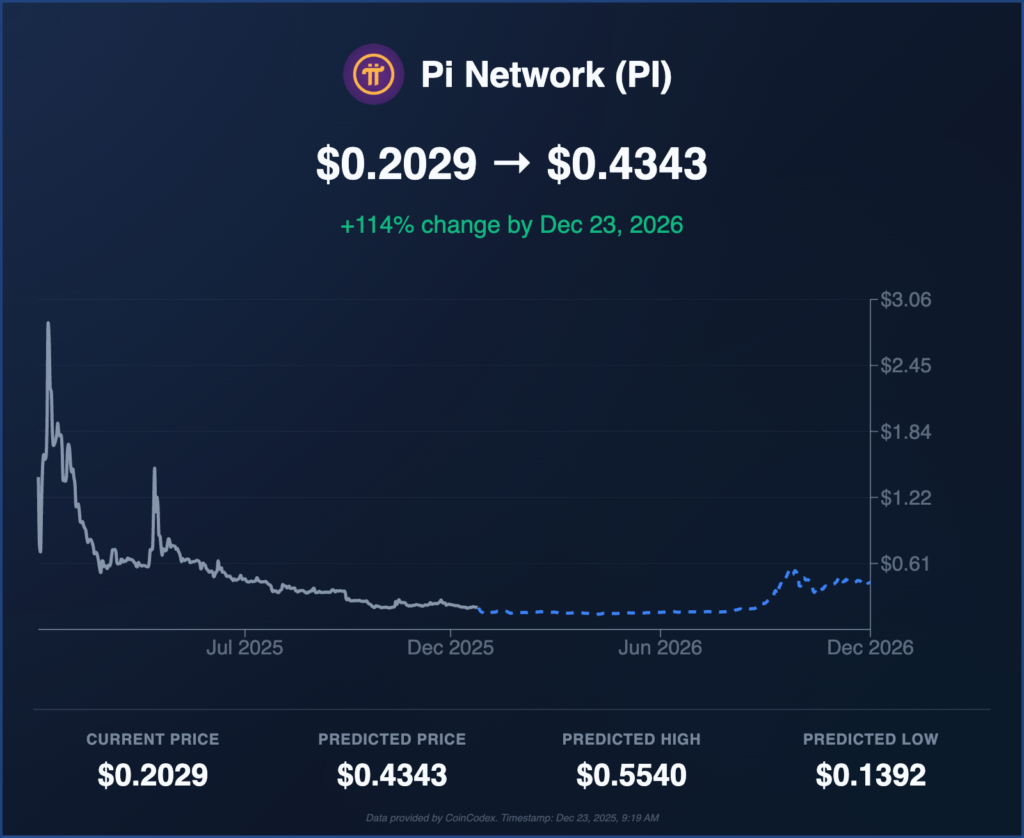
1-Year Pi Coin Price Prediction Chart
Longer term outlook to 2030: possible price ranges and scenarios
By 2030, the gap between the bullish and bearish views becomes very wide. Different sites give very different answers.
A simple way to think about it is with three scenarios.
| Scenario | 2030 rough price range | What it assumes |
| Bear case | ~$0.20 – $0.25 | Adoption stalls, weak liquidity, fading interest |
| Base case | ~$0.30 – $0.50 | Slow but steady usage growth and more listings |
| Bull case | ~$0.75+ (up to ~$0.80+) | Strong ecosystem, broad adoption, better liquidity |
Some models go even higher. A few optimistic sites talk about PI above $2 after 2030, and outliers have thrown around wild numbers like $60 or $200. Those extreme calls are far outside the main cluster of predictions and should be treated as pure speculation.
On the more conservative side, the analysis shows lows in the $0.37 zone by 2030, with potential highs reaching $0.93 if things go reasonably well.
PI is trading below both its 50-day and 200-day moving averages, confirming a broader downtrend, while its 14-day RSI and several momentum indicators sit in oversold territory. This is a setup that often leads to short-term bounces rather than a confirmed trend reversal.
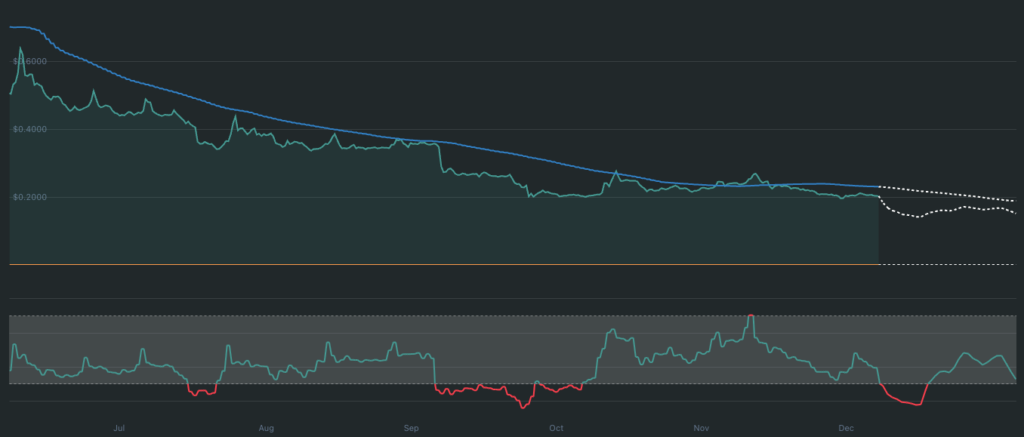
Pi Coin Technical Analysis Chart
Crypto reality rarely looks like the smooth charts on prediction pages. Roadmaps slip, regulations change, communities lose interest, or a new tech trend steals the spotlight. PI is not immune to any of that.
Key drivers that could push PI price up or down
Between 2026 and 2030, a few core forces will guide PI’s path:
- Technology and mainnet stability: If the Stellar-based consensus stays stable, secure, and more decentralized, investor confidence grows. Long outages, bugs, or stalled upgrades would hurt that trust.
- Real adoption by users and merchants: More active wallets, more daily transactions, and more real shops taking PI create real demand. If users only “stack and sit,” demand stays weak.
- Competition from other chains: PI competes with big names like Ethereum and Solana, plus many smaller mobile-friendly chains. If Pi apps stay basic while rivals grow richer ecosystems, capital may move away.
- Regulations and compliance: Pi has made progress by aligning with EU rules like MiCA and using strong KYC. New regulations in key countries could either open doors or close them.
- Tokenomics and unlocks: The supply cap and unlock schedule matter. Unlocking hundreds of millions of tokens can hit price if buyers are not ready. Careful pacing and clear communication help absorb that shock.
- Crypto market cycles: A strong bull market in Bitcoin and large caps usually lifts smaller coins. A long bear market tends to drag everything down, even good projects.
These forces are the bridge between the forecast numbers and reality. Watching them over time gives more insight than staring at price charts alone.
Is now a good time to accumulate PI or should you wait?
This is the big question for many early Pioneers and new investors who are watching PI sit near the low end of its history.
Market sentiment today: fear, low price, and high risk
Late 2025 sentiment around PI leans fearful.
The Fear and Greed style indicators that track PI sit in the “fear” band, around the high 20s or low 30s out of 100. The RSI hovers near the oversold zone, after a long drop from a brief spike near $3 earlier in 2025.
Short-term models show potential dips toward $0.16 to $0.18, with key support around $0.18 to $0.20 and resistance in the $0.23 to $0.24 area. Technical tools also confirm that the main trend is still down, even if small bounces appear.
For a normal person, this means simple things: PI might fall more before any strong recovery, and price swings can be sharp. The project is much less battle-tested than Bitcoin or Ethereum.
You should only consider PI if you accept that risk upfront.
Pros and cons of accumulating PI while it is still cheap
Here is a direct look at both sides.
Pros
- Low entry price under about $0.25 per coin.
- Huge user base, with tens of millions of signups and millions already on mainnet.
- Growing ecosystem, with merchants, Web3 games, and .pi domains.
- Forecasts that, in base or bullish paths, see higher prices by 2030.
- Real-world use inside the network that goes beyond pure trading.
Cons
- Thin liquidity and limited listings on major exchanges.
- High uncertainty around long-term adoption and final tokenomics.
- Centralization concerns and heavy reliance on the core team.
- Regulatory risk if some countries push back on KYC methods or token rules.
- A real chance that forecasts are far too optimistic and price stays low for years.
Cheap does not always equal “good value.” Sometimes it just reflects risk that the market already sees.
Smart ways to build a position in a speculative coin like PI
If you decide PI is worth a small bet, a careful plan can reduce regret.
Here are a few simple ideas:
- Only use money you can afford to lose: Treat PI like a high-risk startup. If losing it would change your life, it is too much.
- Use dollar-cost averaging: Instead of buying a big chunk at once, spread small buys over months. This smooths out your entry price and lowers the impact of short spikes or drops.
- Diversify: Do not let PI become your whole crypto stack. Hold more proven assets too, or even non-crypto investments.
- Set time frames and exit rules: Decide in advance how long you plan to hold and what would make you sell, for example a certain gain, a major trust issue, or a long stall in development.
- Do your own research: Read the whitepaper, follow mainnet updates, and check community channels. Look at what builders and merchants are actually doing, not just what promoters say.
How to research Pi Network before you decide to invest or not
Good research doesn’t have to be complex. You just need to watch the right signals over time and ignore the noise.
Key metrics to track for Pi’s long-term value
Short-term price tells you how people feel today. Long-term value comes from utility and trust.
Useful metrics to follow:
- Active users and nodes: Is the number of daily active wallets and validator nodes growing, flat, or falling?
- Apps and merchants: Are more merchants and apps accepting PI every quarter, or has growth stalled?
- Mainnet upgrades and decentralization: Does the team publish clear technical updates and move control toward the community?
- KYC progress and mainnet migration: Are more Pioneers clearing KYC and getting their coins onto mainnet wallets?
- Roadmap and governance: Is there a public roadmap with realistic dates, and a way for the community to give input?
Check these points every few months or weeks at most, not every few hours. This will tell you if PI is drifting toward the bull, base, or bear path we discussed earlier.
Red flags and risks you should not ignore
There are also warning signs that deserve attention.
Some examples:
- Tokenomics that keep changing without clear reasons.
- Long delays or missed milestones, with weak or vague communication.
- Very slow progress on listings at reputable exchanges over several years.
- Legal or regulatory actions in big markets that mention Pi by name.
- Trading patterns that look like wash trading or fake volume.
The bottom line
Pi Network stands in a strange place. It has a huge community, a live open mainnet, growing merchant use, and solid progress on KYC and compliance. At the same time, PI trades under about $0.25, with thin liquidity, high fear, and major uncertainty about long-term value.
Most 2026 forecasts point to a wide range, roughly $0.14 to $0.50, with many models centering near $0.23 to $0.26. For 2030, scenarios stretch from under $0.25 in a weak case to around $0.75 or a bit higher in a strong case, with a middle band near $0.30 to $0.50. These are models, not promises.
- For some investors, it may make sense to start slowly, treat PI as a small, long-term speculative bet, and use dollar-cost averaging
- For others, the risk, uncertainty, and thin markets will be a deal-breaker, and that is completely reasonable
Whatever you choose, protect yourself first. Do your own deep research, keep PI as a limited part of a broader portfolio, and only risk what you can afford to lose. The next few years of real adoption and tech progress will matter far more than any single price prediction on a chart.