




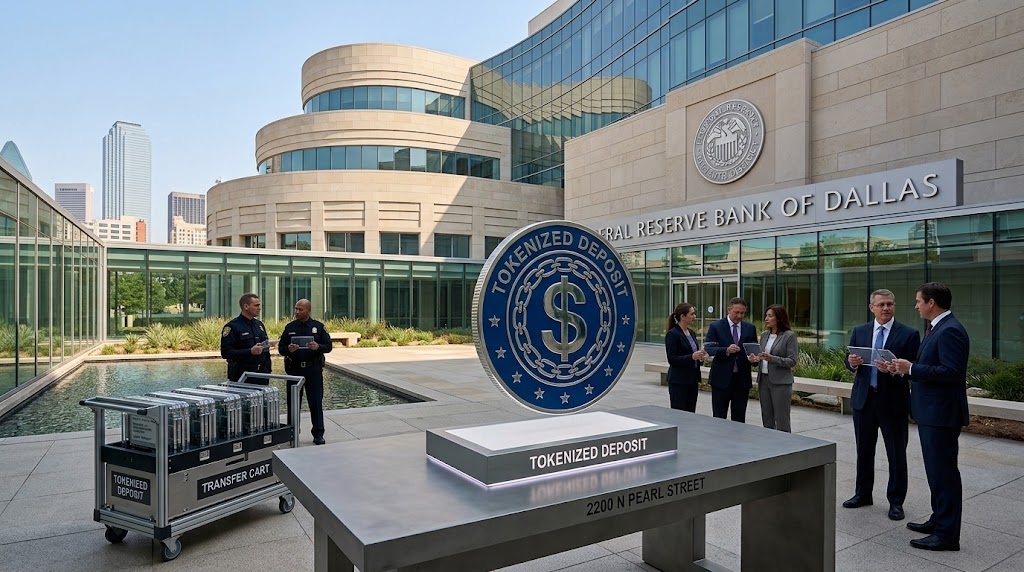
- Dallas Fed economists warn that tokenized deposits could shorten the lifecycles of deposits held in banks.
Tokenized deposits have emerged as a formidable challenger to the rising dominance of stablecoins. However, the Federal Reserve Bank of Dallas recently warned of their detrimental effects on banking customers, particularly borrowers.
Stablecoins Vs Tokenized Deposits
Stablecoins are among the fastest-rising crypto assets by market cap and use cases. These are digital assets pegged 1:1 to the value of a fiat currency, such as the US dollar, with reserves typically held off-chain or in short-term government treasuries. Due to their current operation running across the gray area of US regulations, as the GENIUS Act is still pending enforcement while the CLARITY Act is stuck in legislative limbo, they offer users greater flexibility than tokenized deposits.
On the other hand, tokenized deposits are a digital representation of an existing bank deposit liability. They offer the same settlement capabilities as stablecoins. However, they benefit from the same regulatory safeguards, such as Federal Deposit Insurance Corporation (FDIC) insurance on certain thresholds, and backstops that govern commercial banking,
In the US, where stablecoin yields remain a sticky topic among regulators, tokenized deposits, by default, have no problem issuing yields found in conventional bank deposits.
Dallas Fed Sees Detrimental Effects of Deposit Tokens on Traditional Bank Deposits
A note by Fed economists Rosie Levy and Srini Ramaswamy highlighted that deposit tokens indeed open banking customers to near-real-time settlement and 24/7 liquidity. But large-scale adoption could eventually backfire, and borrowers would take the brunt of the consequences.
The Fed economists emphasized that deposit tokens enable depositors to take advantage of the near-instant settlement cycles to switch banks at a moment’s notice. Their turnaround times can be amplified by the automation brought by smart contracts and agentic AI (artificial intelligence).
The trend will mean shorter lifecycles for deposits held in banks. It would also make them more sensitive to interest rate fluctuations.
Levy and Ramaswamy projected that a 10% increase in the price sensitivity of deposits to interest rates, based on a 10-year duration, would reduce banks’ ability to hold long-term loans and other assets by approximately $700 billion. Meanwhile, a 10% reduction in the weighted average life (WAL) of deposits over the same benchmark would cause a $580 billion shrinkage in the maturity transformation capacity of banks.
Ultimately, the scenario would make bank funding less stable. Furthermore, it would raise credit costs for individual and enterprise clients.